

Introduction
Medical admission in India is a structured and highly competitive process. While most students focus primarily on their NEET score and rank, an equally important factor that determines admission opportunities is the Seat Matrix. The seat matrix provides the official distribution of available medical seats across different categories and quotas in medical colleges.
Understanding the seat matrix is essential for every NEET aspirant because it reveals the actual seat availability for each category, which directly affects admission probability. Without analyzing the seat matrix, students cannot accurately estimate their chances of securing admission in medical colleges.
This article explains the concept of the seat matrix, reservation categories, vertical and horizontal reservations, the seat roster system, and quota distribution in medical admissions. A clear understanding of these aspects helps students plan their admission strategy in a structured and informed manner.
What is the Seat Matrix in Medical Admissions?
The Seat Matrix of a state represents the official distribution of available medical seats across different categories and quotas in medical colleges. It shows how total seats are divided for various reservation categories and admission quotas, helping NEET aspirants understand the real seat availability structure before counselling and admission planning.
In medical admissions, the seat matrix plays a crucial role because seat availability and merit distribution are directly linked. The number of seats allocated to each category influences the admission opportunities available to students belonging to that category.
For NEET aspirants, the seat matrix serves as an essential planning tool because it helps in:
- Understanding category-wise seat availability
- Analyzing admission probability based on rank and category
- Making informed decisions during counselling
- Evaluating realistic admission possibilities
Therefore, students should always study the seat matrix carefully before participating in the counselling process.
Dynamic Nature of the Seat Matrix
One important aspect of the seat matrix is that it is not fixed. The seat matrix is dynamic and can change every year due to multiple factors.
These changes may occur due to:
- Increase in medical seats
- Addition of new medical colleges
- Policy changes by authorities
- Changes in reservation policies
- Government decisions regarding medical education expansion
Because of these variables, students must always refer to the latest seat matrix released for the specific admission year. Using outdated seat data may lead to incorrect admission planning and unrealistic expectations.
State Seat Matrix vs All India Quota Seat Matrix
Medical seats in India are divided into two major categories based on admission jurisdiction.
State Quota Seat Matrix
The state seat matrix mainly reflects seats reserved under the state quota, which are filled through the respective state counselling authorities. These seats are usually available to candidates who fulfill the state domicile eligibility criteria.
Each state releases its own seat matrix during counselling that shows the distribution of seats across government and private medical colleges within that state.
All India Quota (AIQ) Seat Matrix
The All India Quota (AIQ) seat matrix is released separately and represents seats that are filled through national-level counselling.
AIQ seats are available to eligible candidates from across the country and are not limited to state-domiciled candidates.
For complete admission planning, students must analyze both the State Quota seat matrix and the AIQ seat matrix together. Only by combining both datasets can students estimate their full range of admission opportunities.
What is the Reservation Category in Medical Admission?
Reservation categories in medical education refer to the allocation of seats to different castes, communities, and special groups to ensure fair representation and equal access to medical education.
These reservation provisions are implemented as part of the government’s policy to create balanced educational opportunities across different sections of society.
For NEET aspirants, understanding reservation categories is extremely important because:
- Seat availability differs across categories
- Competition level varies by category
- Cut-offs differ for each reservation category
- Admission probability depends on category-wise seat distribution
Since the seat matrix is structured around reservation categories, students must understand reservations before analyzing the seat distribution.
Types of Reservations in Medical Education
Medical admissions generally include two types of reservations:
- Vertical Reservation
- Horizontal Reservation
Both play different roles in the seat distribution process.
Vertical Reservation
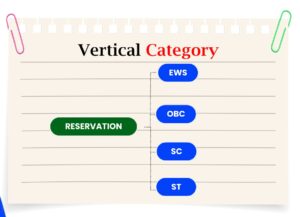
Vertical reservation is the primary category-based reservation system used in medical admissions. It divides the total seats into major social categories.
The major vertical reservation categories include:
- SC (Scheduled Castes) – 15%
- ST (Scheduled Tribes) – 7.5%
- OBC (Other Backward Classes) – 22.5%
- EWS (Economically Weaker Section) – 10%
- General Category (Open Merit) – Remaining seats
These percentages are applied to the total seats in a medical college to distribute seats across categories.
Vertical reservations define the basic structure of seat allocation in the seat matrix.
Horizontal Reservation
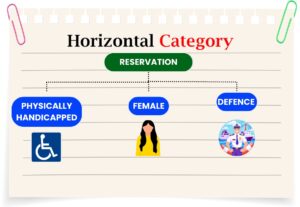
Horizontal reservation operates within the vertical categories and applies across all reservation groups.
This means that horizontal reservations are not separate categories but adjusted within the existing vertical reservations.
Common examples of horizontal reservations include:
- PWD (Persons with Disabilities)
- Female candidates
- Defense category
For example, if a certain number of seats are reserved for PWD candidates, those seats are adjusted within each vertical category, such as SC, ST, OBC, EWS, or General.
Thus, horizontal reservations are layered on top of vertical reservations and require careful analysis while interpreting the seat matrix.
Seat Roster System: How Reservation Seats Are Calculated
In many cases, the percentage-based calculation of reservation seats results in decimal numbers rather than whole numbers.
To manage this situation, medical admissions use a system known as the Seat Roster System.
This system ensures that reservation percentages are maintained accurately over multiple years.
For example:
If a reservation calculation results in 9.4 seats, the allocation may work as follows:
- In the current year, the seat count may be 9 seats
- In the next year, the seat count may become 10 seats
This adjustment occurs because decimal fractions accumulate over time, ensuring that the reservation percentage remains proportionally correct in the long run.
The seat roster system, therefore, maintains fair and balanced distribution of seats over multiple admission cycles.
Example of Reservation Seat Distribution
Consider a medical college with 100 MBBS seats.
Based on standard vertical reservation percentages, the distribution may look like this:
- SC – 15 seats
- ST – 7.5 seats
- OBC – 22.5 seats
- EWS – 10 seats
- General Category – Remaining seats
Since ST and OBC calculations include decimal values, the actual seat allocation may vary slightly each year.
For example:
- ST may have 7 seats in one year and 8 seats in the next year
- OBC may have 22 seats in one year and 23 seats in the next year
This variation occurs because of the seat roster system, which balances the distribution over time.
Quotas in Medical Admissions (Separate from Reservation Categories)
Apart from reservation categories, medical admissions may also include special quotas. These quotas are different from reservations and apply under separate provisions.
Some common quotas include:
- NRI Quota
- Freedom Fighter Quota
These quotas may exist in certain states or specific institutions. The exact quota availability varies from state to state and must be checked in the state-wise seat matrix released during counselling.
Why Seat Matrix Analysis is Crucial for NEET Aspirants
The seat matrix provides a structured view of how total medical seats are distributed across:
- Vertical reservation categories (General, SC, ST, OBC, EWS)
- Horizontal reservations (PWD, Female, Defence)
- Admission quotas (State Quota, Management Quota, NRI Quota)
Without analyzing this structured distribution, students may misunderstand the real level of competition within their category.
Many aspirants make the mistake of focusing only on NEET rank, without studying how seats are distributed across categories and quotas. However, admission probability depends on the combination of rank, category, and seat availability.
Additionally, when the seat matrix is updated every year, admission probabilities also change. New colleges, increased seats, or policy modifications can significantly impact the counselling outcomes.
Another complex aspect that students often fail to understand is how horizontal reservations collapse into vertical categories and how quota allocation influences the final seat availability.
Therefore, proper seat matrix analysis is essential for accurate counselling strategy and realistic admission planning.
The seat matrix is one of the most important components of medical admission planning. It provides a clear picture of how medical seats are distributed across categories, reservations, and quotas.
For NEET aspirants, understanding the seat matrix is not optional; it is necessary for making informed counselling decisions and estimating admission chances accurately.
Students who carefully study the seat matrix gain clarity about:
- Category-wise seat availability
- Competition level within their category
- Impact of reservations and quotas
- Realistic admission opportunities
A proper understanding of these factors allows students to approach counselling with confidence, strategy, and clarity.
NEET Navigator: Expert Guidance for Medical Admission Planning
Understanding the seat matrix, reservation policies, and counselling strategies can be extremely complex for students and parents. Even small misunderstandings about category distribution or quota allocation can lead to incorrect choice filling and missed admission opportunities.
This is where NEET Navigator provides structured and expert guidance.
NEET Navigator helps students with:
- Detailed seat matrix analysis for every state
- Category-wise admission probability evaluation
- Strategic choice filling guidance
- Personalized counselling planning based on NEET rank
- Complete support for the state and All India counselling processes
With the right analysis and planning, students can maximize their chances of securing admission in the best possible medical college according to their rank and category.
If you want to make informed, strategic, and regret-free admission decisions, expert guidance from NEET Navigator can make the entire counselling process clearer, structured, and more effective.